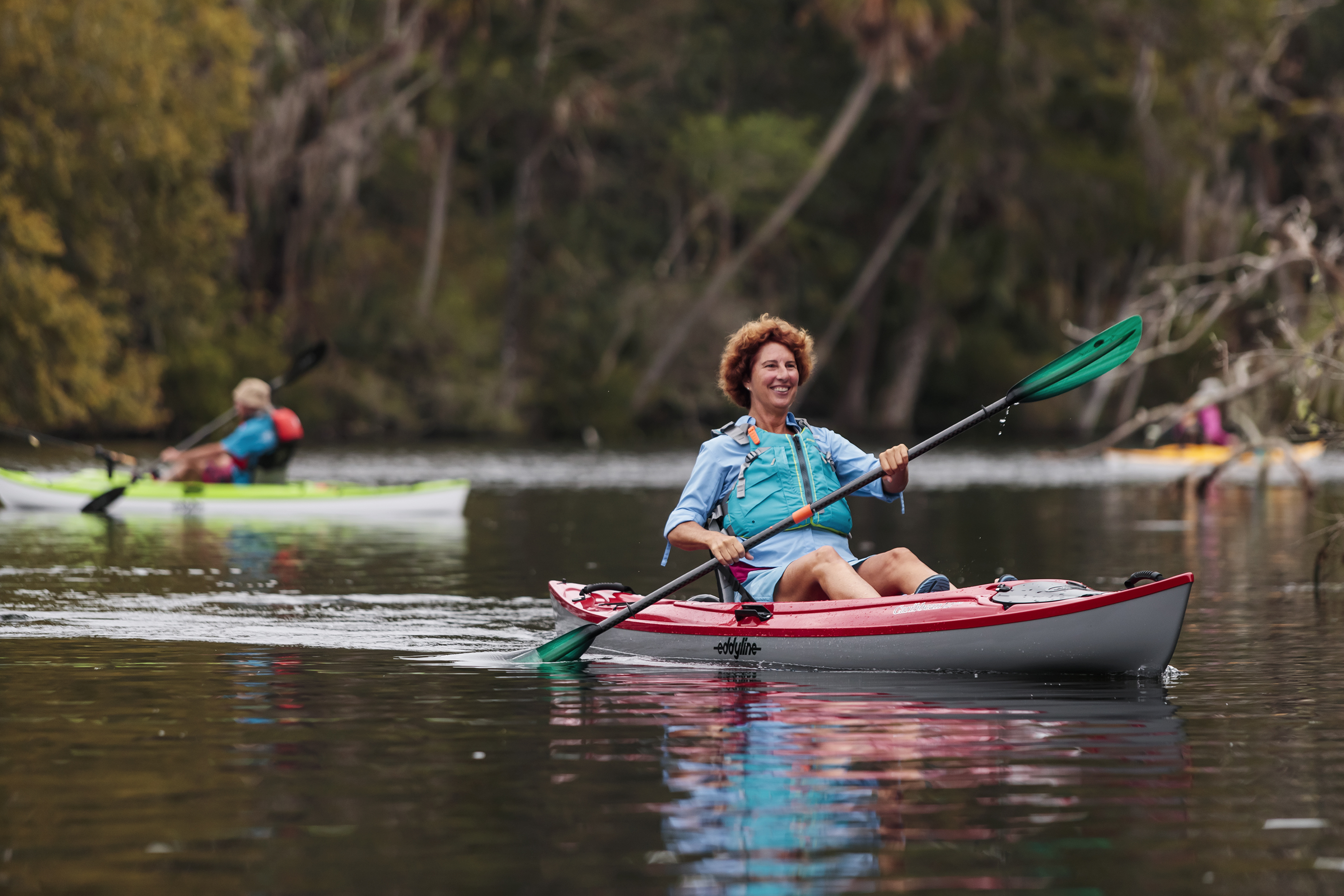
You don't need an expedition kayak to enjoy Indiana's waterways. You need a boat that feels comfortable, handles predictably, and makes getting on the water something you look forward to.
From the calm water of Eagle Creek to the gentle stretches of the White River and Sugar Creek, Indiana offers plenty of opportunities for recreational paddling. But the kayak that feels right on a wide-open reservoir may not be the one you'd choose for a narrow, winding stream.
At Rusted Moon Outfitters, we help people find kayaks that fit their experience, their plans, and the practical realities of getting a boat to and from the water.
This guide builds on some of the recreational designs we've recommended over the years, with a closer look at where each style makes sense.
01 / Start with the water
Not All Indiana Waterways Are Alike.
Before comparing brands or specifications, think about where you'll spend most of your time paddling.
Calm Lakes
Comfortable seating, efficient tracking, and a predictable hull are valuable for relaxed outings and longer paddles.
Easy Rivers
A balance of tracking and maneuverability helps when navigating bends, mild current, and changing conditions.
Small Streams
Turning ability, hull durability, and suitable water depth become especially important.
A longer kayak will often track more efficiently across open water. A shorter boat can be easier to turn in tighter spaces. Neither characteristic tells the whole story, though. Hull shape and overall design matter just as much.
A shallow creek with downed trees, strainers, or fast current can be more hazardous than a calm lake. Recreational kayaks aren't appropriate for every river condition. Always research the route, water level, hazards, and access before launching.
02 / Beyond the price tag
Why a Better Recreational Kayak Matters
There are inexpensive kayaks that will get you onto the water. For an occasional short outing, one may be all you need.
But once you begin paddling regularly, the differences in seating, hull design, construction, and handling become much more noticeable.
- Comfort: Supportive seating can make longer outings far more enjoyable.
- Tracking: A kayak that holds its direction reduces unnecessary corrective strokes.
- Stability: A well-designed hull balances initial steadiness with predictable behavior as the boat leans.
- Fit: Cockpit dimensions, seat adjustment, legroom, and capacity all affect the experience.
- Transport: A kayak that's difficult to lift or carry may discourage you from using it.
The goal isn't necessarily to buy the most expensive kayak. It's to find something you'll enjoy using for years.
03 / Boats worth considering
Our Recreational Kayak Shortlist
These are models and families of kayaks featured in our original Rusted Moon guide. They're useful reference points for understanding different paddling styles. Current models and availability should be confirmed with the shop.
Easygoing & Approachable
Perception Sound 10.5
Dagger Axis 10.5
For paddlers who want a manageable recreational kayak without unnecessary complexity, these are sensible places to begin.
The Sound 10.5 offers a straightforward recreational platform, with features that can appeal to casual paddlers and anglers.
The Axis 10.5 brings a different personality, combining recreational comfort with a design intended for more varied water.
Best suited for: Casual outings, protected lakes, and appropriate easy river sections.
Worth considering: Shorter boats can be easier to store and maneuver, but may not glide as efficiently over distance as longer designs.
Comfortable All-Around Paddling
Wilderness Systems Pungo 120 / 125
Wilderness Systems Aspire 105
Dagger Axis 12.0
If you're planning to paddle regularly, spend more time on the water, or explore a mix of lakes and rivers, this group deserves a closer look.
The Pungo family is known for recreational comfort, roomy cockpits, and an enjoyable cruising experience on relatively calm water.
The Aspire 105 offers a compact, versatile approach, while the longer Axis 12.0 can appeal to paddlers looking for more efficiency without abandoning river versatility.
Best suited for: Regular recreational paddling, lakes, reservoirs, and suitable slow-moving rivers.
Worth considering: Extra length can improve cruising, but it also affects transport, storage, and turning in tight spaces.
Open, Stable & Accessible
Wilderness Systems Tarpon 120
Perception Pescador 12.0
Sit-on-top kayaks offer a different kind of experience. With an open deck and accessible seating, they appeal to paddlers who prefer not to sit inside a cockpit.
The Tarpon 120 and Pescador family are examples of recreational sit-on-tops that work well for relaxed paddling and fishing.
Most recreational sit-on-tops include scupper openings that allow water on the deck to drain. They're especially appealing in warmer conditions.
Best suited for: Warm-weather outings, fishing, casual paddling, and people who prefer an open seating area.
Worth considering: You're more exposed to water and weather. Weight and width can also vary considerably between models.
These models are examples from our earlier buying guide, not a live inventory list. Designs, specifications, and availability can change. Contact Rusted Moon for current options.
04 / Understanding the details
Does Kayak Length Matter?
For many recreational paddlers, kayaks in roughly the 10- to 12-foot range offer a useful balance of manageability and performance.
But a few inches of length don't tell you everything. The width, hull profile, rocker, and intended purpose can dramatically change how a kayak handles.
| Characteristic | Shorter Recreational Kayak | Longer Recreational Kayak |
|---|---|---|
| Turning | Often easier to maneuver | May require more effort to turn |
| Tracking | May need more correction | Often holds a line more easily |
| Distance | Well suited to shorter outings | Often more efficient for longer paddles |
| Transport | Generally easier to store | Requires more space |
| Best environment | Tighter waterways and casual use | Open water and mixed recreational use |
General tendencies only. Hull design, width, weight, and construction can change these characteristics.
05 / Sit-inside or sit-on-top
Two Ways to Enjoy the Water
A sit-inside kayak positions you within a cockpit, providing some protection for your lower body and often a connected paddling feel.
A sit-on-top places you on an open deck, making entry, exit, and access to gear more straightforward for many paddlers.
Neither style is automatically more stable or better for beginners. Stability depends heavily on hull design, width, and conditions.
We've put together a separate guide that explores the differences in much greater detail.
06 / Practical considerations
Don't Forget About Getting There.
The experience starts before the kayak touches the water. Consider where you'll store it, how you'll transport it, and whether you can comfortably lift and carry it.
A larger, more feature-rich kayak may feel excellent on the water but become frustrating if it's difficult to load onto your vehicle.
Check your vehicle and rack manufacturer's load limits, use appropriate tie-downs, and make sure the kayak is secured correctly.
A detail worth remembering
Weight Can Change Everything.
Some paddlers focus entirely on comfort and stability, only to discover that lifting the kayak is the hardest part of the outing.
Lighter construction, including thermoformed designs like those offered by Eddyline, may be worth considering if transport is a major concern.
The best kayak isn't much use if getting it to the water feels like a chore.
07 / Finding your fit
A Simple Way to Choose
You don't need to memorize every specification. Start with a few practical questions.
What sounds most like you?
- I want something simple for occasional paddling. Begin by comparing compact recreational designs like the Sound 10.5 and Axis 10.5.
- I want to paddle regularly and explore farther. Look at the Pungo family, Aspire 105, and Axis 12.0.
- I prefer an open deck or want to fish. Compare sit-on-top designs like the Tarpon and Pescador.
- I'm concerned about lifting and transporting it. Compare actual boat weights and consider lighter construction.
- I paddle narrow, shallow, or obstructed waterways. Prioritize the conditions and choose an appropriate design rather than assuming any recreational kayak will work.
Most importantly, consider how the boat fits your body. Seat comfort, legroom, cockpit access, and weight capacity should be part of the decision.
Before You Launch
Even familiar Indiana waterways deserve preparation. Water levels and current can change, and a quiet-looking river can conceal submerged obstacles.
- Wear a properly fitted, appropriate personal flotation device.
- Check weather, water temperature, river levels, and current conditions.
- Research access points, hazards, and your intended route.
- Avoid low-head dams, strainers, and water beyond your skill level.
- Know how to recover from a capsize and dress for immersion conditions.
- Let someone know where you're paddling and when you expect to return.
The Best Kayak Is the One You'll Use.
The right boat doesn't have to be the fastest, longest, or most expensive. It should feel comfortable, suit the water you enjoy, and make the whole experience easier and more rewarding.
If you're in Indianapolis, stop by Rusted Moon Outfitters in Broad Ripple. We'll help you compare recreational designs, discuss the places you paddle, and find something that makes sense for you.
Call us at (317) 253-HIKE or visit the shop.